A cross foundation. Three radically different fields.
From agricultural biotechnology to an industry in China and the preparation of a public decision: the same principle remains. Before multiplying solutions, make reality readable, define the future condition and govern the passage.
Hachi / Panama + ColombiaValley / ChinaPort Seco / Brazil
01 / What crosses the three fields
Foundation is not a report. It is the condition for the next decision.
01
Common reality
Facts, limits, dependencies, and capabilities no longer remain scattered.
02
Defined move
The target state and structuring choices gain operational form.
03
Installed governance
Authority, evidence, sequence, and passing criteria guide execution.
Case 01 / Hachi / Agriculture + biotechnology
From lab to market, a chain must preserve context.
The consultancy's historical performance required reading a reality that spanned laboratory, farm, processing, quality, stock, and marketing in operations in Panama and Colombia. Organic growth and specialized knowledge existed, but management and governance needed to keep pace with the complexity of the cycle.
Learning for the Foundation is direct: before digitizing or standardizing, it is necessary to make visible the relationships between science, field, production, decision, and responsibility.
LaboratoryFieldProcessingQualityMarket
Case 02 / Valley Coffee / Industry
The method entered through the factory door.
A ten-day sprint in China consolidated a baseline of the current state with 122 encoded photographs, evidence classes, and a work architecture organized into 14 fronts. The governing principle was explicit: the physical operating system comes first; the digital platform records and strengthens, but does not replace work that has not yet been defined.
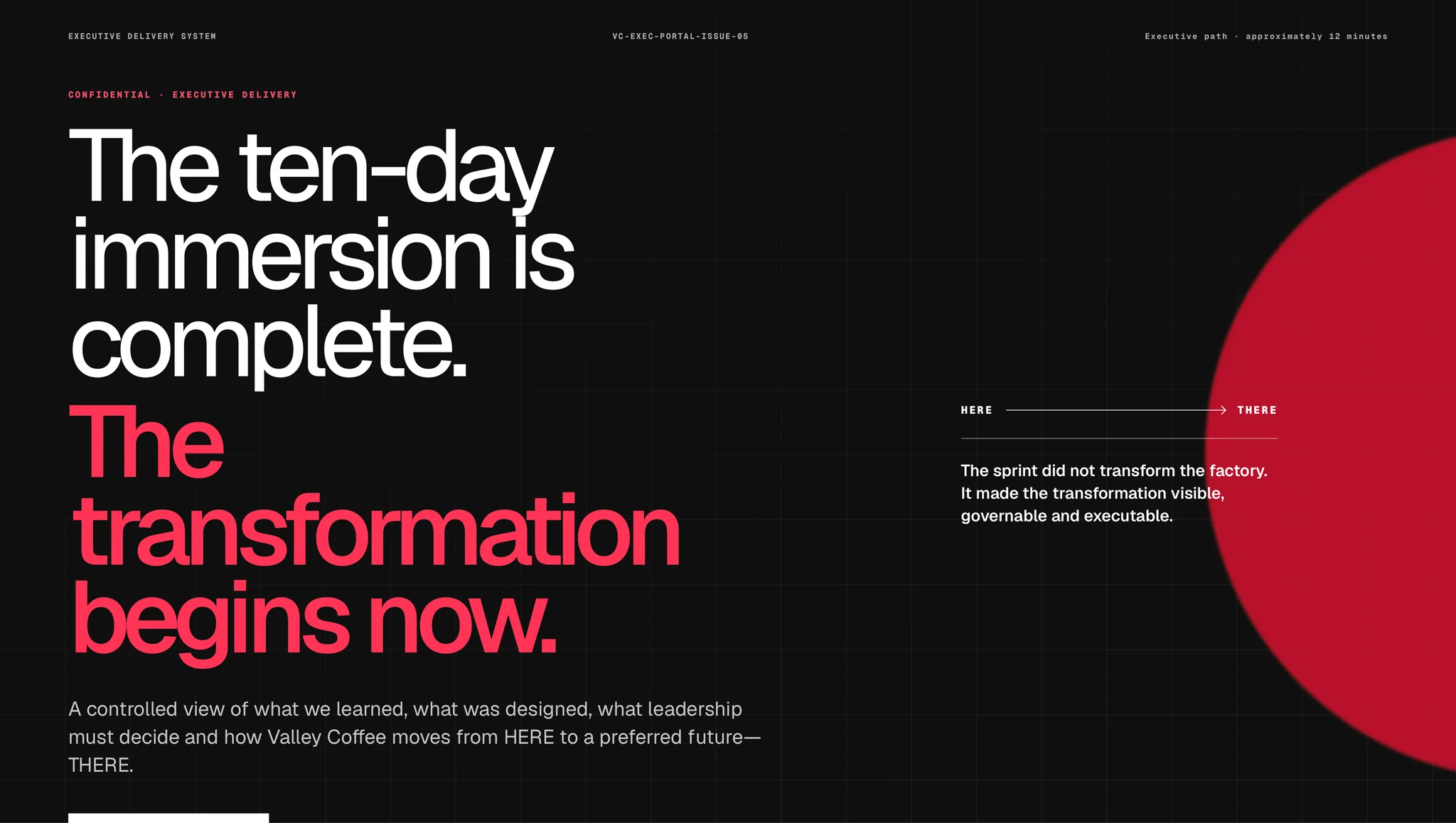
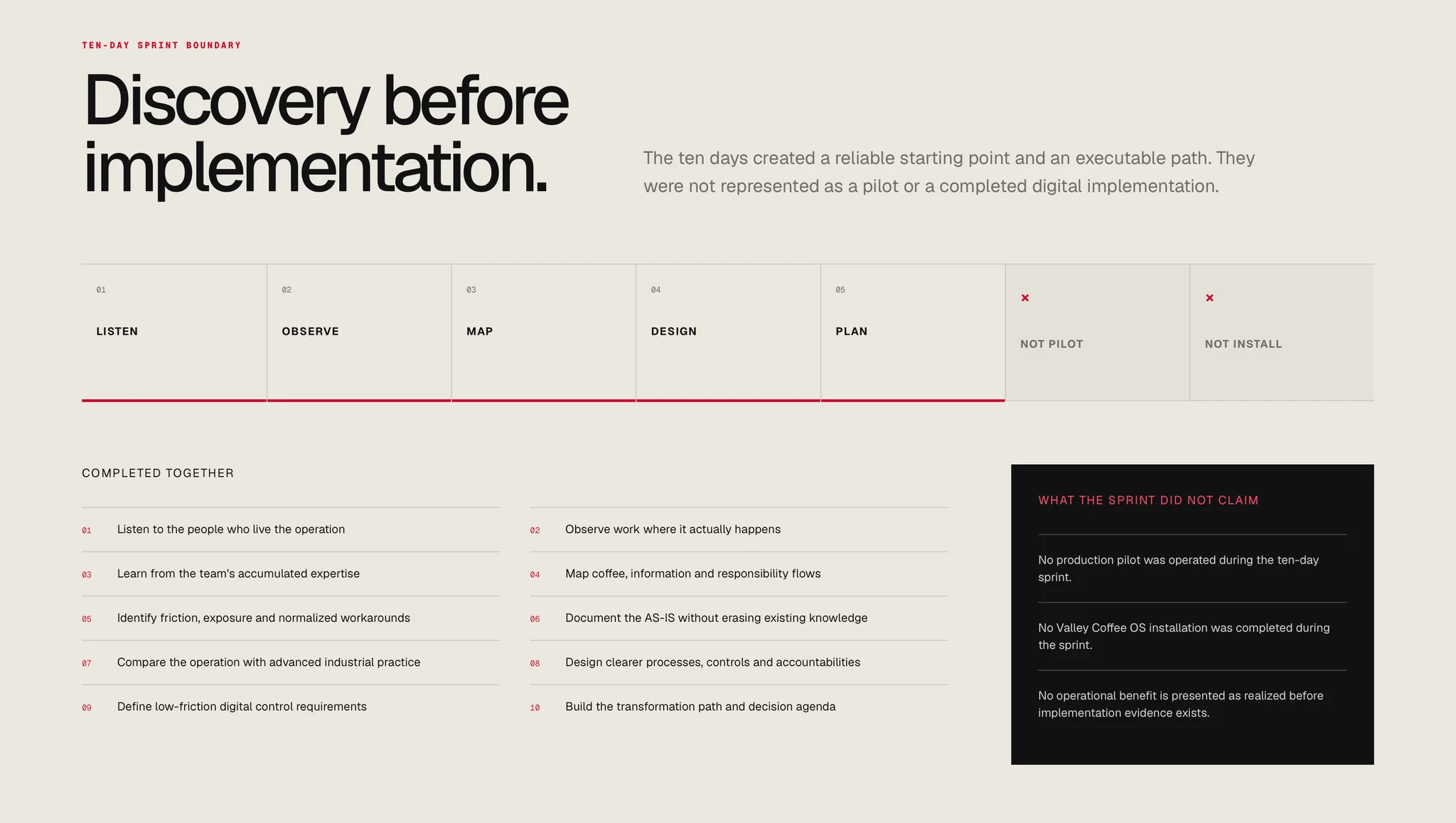
The sprint did not transform the factory. It made transformation visible, governed, and executable.
10days of immersion122encoded photographs14work fronts71tasks preserved in the archive
Valley / Delivery Governance
Two spaces. Different authorities.
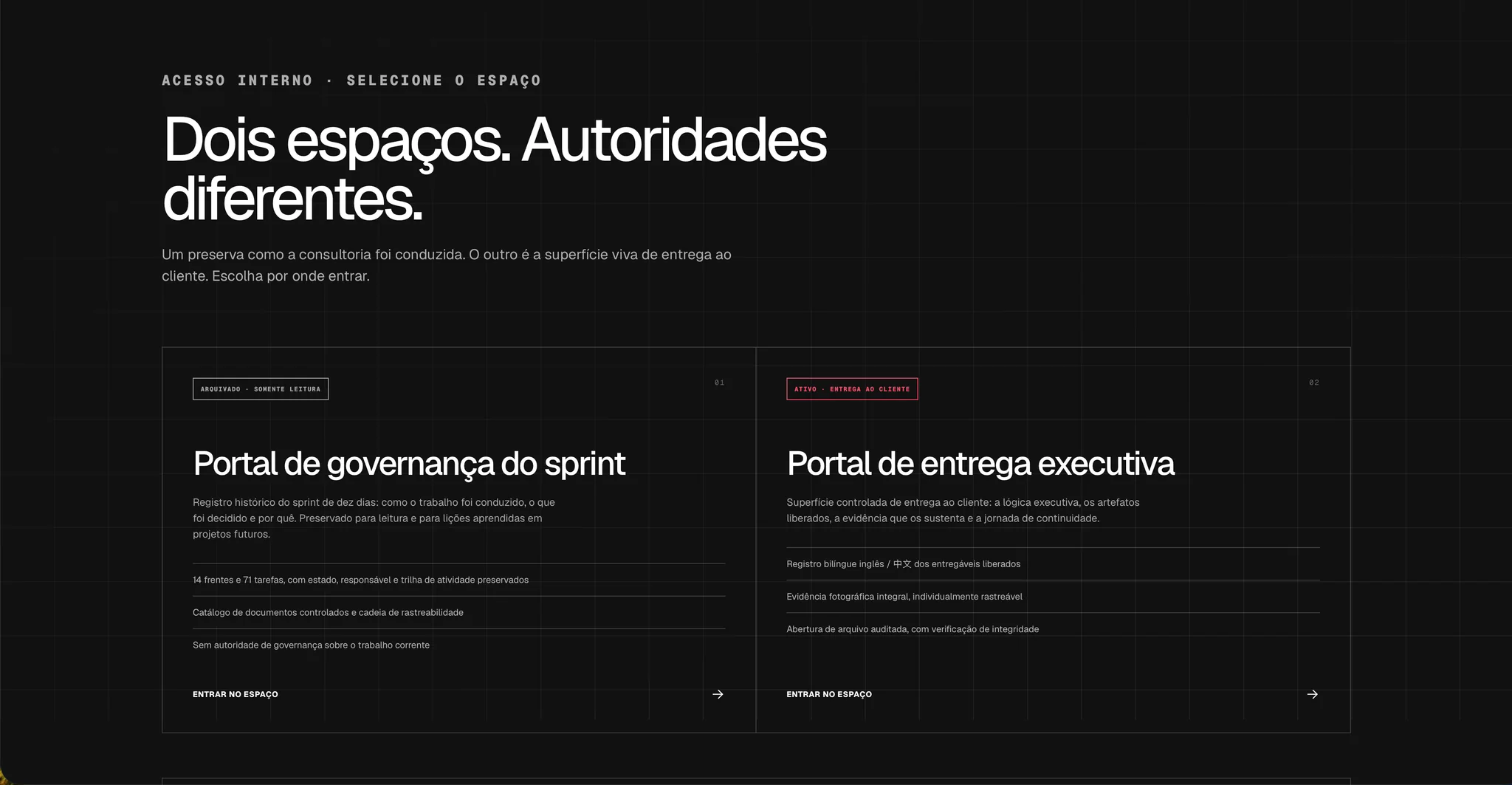
A portal preserves how the sprint was conducted, what was decided and why. The other delivers to the client the released artifacts, the evidence that sustains them, and the journey of continuity. A historical file is not confused with an active queue; delivery does not rewrite history.
01 / Input / two spaces02 / Archive / institutional memory03 / Delivery / executive transition04 / Limit / discovery before implementation05 / Decision / HERE → THERE
05 views / 01 system
Input / two spaces. Entry screen separating the historical governance sprint portal and the active executive delivery portal.
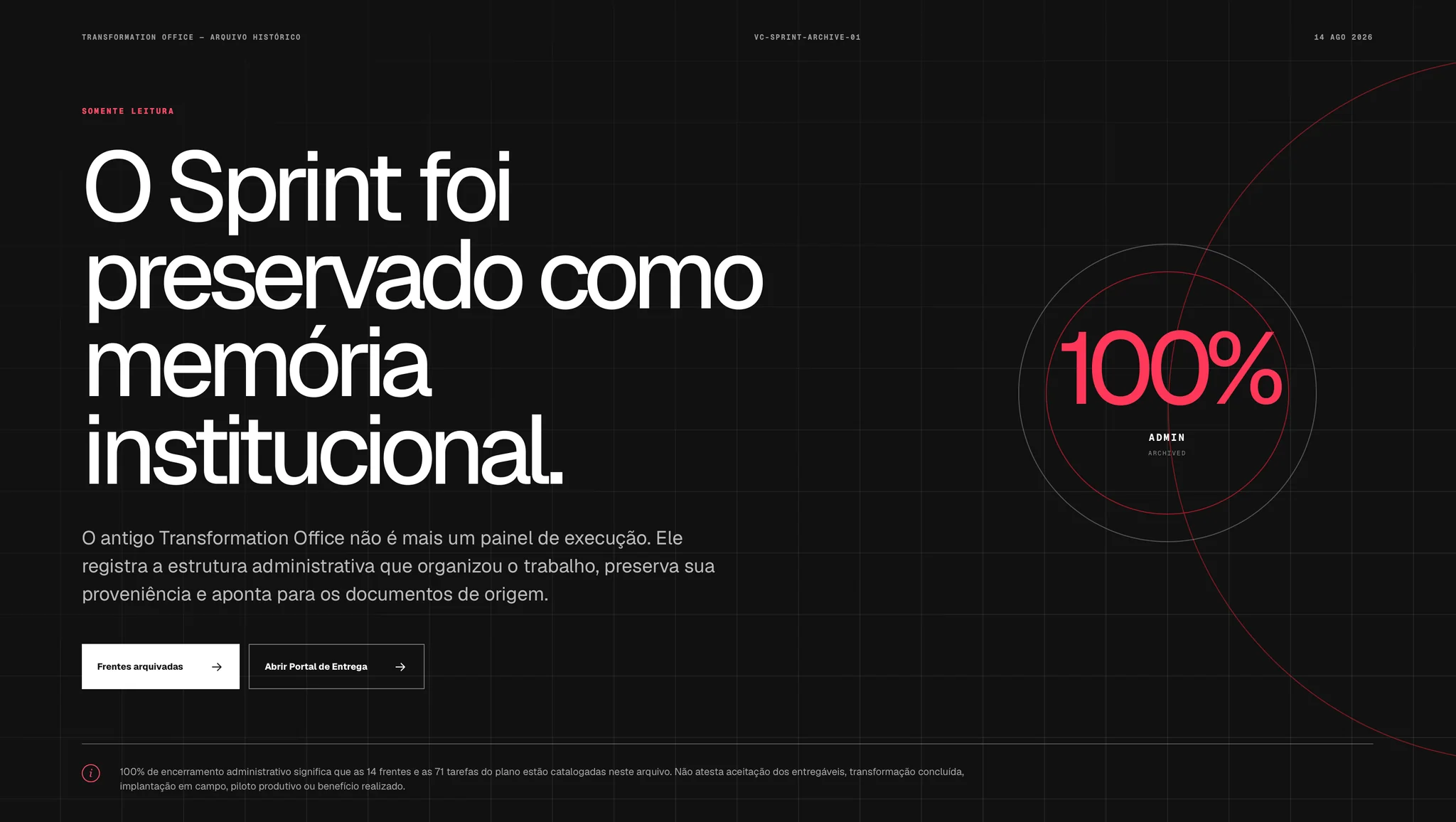
Archive / institutional memory. Read-only archive that preserves structure, decisions, and sprint provenance as institutional memory.
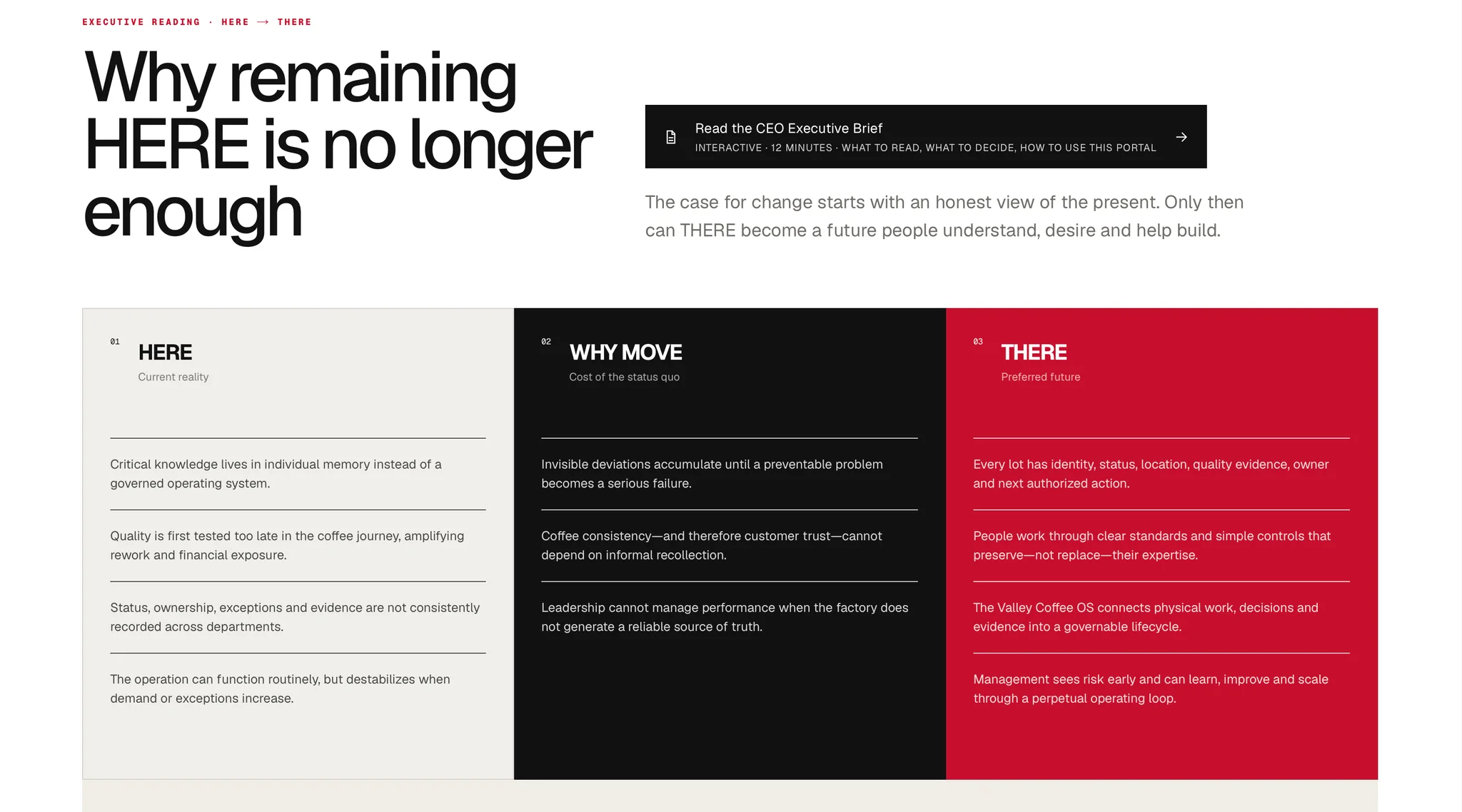
Delivery / executive transition. Executive portal that presents the passage between current reality and the preferred future without claiming completed transformation.
Limit / discovery before implementation. A framework that distinguishes listening, observation, mapping, design, and planning from an unrealized pilot or installation.
Decision / HERE → THERE. Executive reading that organizes current reality, cost of staying, and preferred future condition.
Case 03 / Dry Port of Pedro Leopoldo / Public Decision
Decide whether there is a basis to proceed before funding the full study.
The Initial Viability Synthesis was structured to organize the municipal decision prior to a formal EVTE: logistic diagnosis, benchmarks, candidate areas, preliminary infrastructure, regulatory requirements, conceptual estimation, and roadmap for the next stage.
The value of the Foundation in this context is to reduce the uncertainty of the initial decision. Instead of confusing future depth with immediate spending, the approach builds proportional evidence to determine if the municipality has sufficient ground to proceed.
01
Question
Is there a logistical, territorial, and institutional basis to continue?
02
Base
Sources, candidate areas, requirements, risks, and premises organized.
03
Next decision
Move forward, adjust the perimeter, or interrupt before the larger investment.
04 / Cross-functional learning
The sector changes. The function of the foundation remains.
On the farm, it connects science, production, and governance.
In industry, it transforms field observation into baseline, decisions, and continuity.
In public administration, it organizes a proportional decision before the commitment of higher cost.